Have you ever been in this situation?
You’re solving a math problem and after you have crafted what formulas to use and how to calculate in your mind, you mind that there are two outcomes of the problem, one slightly more accurate than the other.
This is a classic demonstration of the Probability Concept.
The topic of the problem does not only test the right formula to use but also how carefully you think, that is your logic and reasoning power.
In the Singapore MOE syllabus, this chapter carries weight from secondary levels all the way to JC H2 Mathematics. Students who understand it well often gain a strong advantage in their exams. Those who rely only on memorising steps usually struggle when the question is framed differently.
Our maths tuition at Miracle Learning Centre covers this concept in a realistic, practical manner. We can help you see the structure behind every scenario so you can approach unfamiliar problems with confidence.
Core Ideas Of The Probability Theory
What is the logic behind the probability concept? Before you sit for your exams, it’s essential to know the concept, its core ideas and variations.
Well, in the simplest terms, it is a numerical measure between 0 and 1 that describes how likely an event is to occur.
Still confused?
Consider the following example:
You are asked to find the likelihood of drawing a red card from a standard deck of 52 cards
- First, you define the sample space. There are 52 possible cards.
- Next, you define the event. There are 26 red cards.
Using classical probability, you calculate:
Number of favourable outcomes divided by total outcomes
26 divided by 52 equals 1 divided by 2.
This value tells you there is a one in two chance of selecting a red card.
Now consider a slightly different question. Suppose you are told one card has already been removed and it is black.
- The total number of cards changes.
- The sample space changes.
And this is where conditional probability comes in. You must adjust your reasoning based on new information.
Let’s now break down the core ideas, for you to understand better.
Sample Space
This is the complete set of all possible outcomes in the concept of probability. If the sample space is incomplete, every answer that follows will be wrong. We train students to define it carefully before moving forward with the calculations.
Events
An event is a specific outcome or group of outcomes within the sample space. Recognising whether events overlap or remain separate is essential.
Classical Probability
Now, this is based on equally likely outcomes.
The formula, number of favourable outcomes divided by total outcomes, is introduced early in secondary school and forms the backbone of many problems.
Theoretical Probability
This is calculated using mathematical reasoning without conducting experiments. It assumes perfect conditions and equal likelihood.
Experimental Probability
Here, students learn why results from experiments may vary slightly due to randomness. The value is generally found by carrying out the experiment in real life and recording the results, instead of calculating it using a formula.
At our maths tuition centre, our tutors spend adequate time comparing theoretical and experimental approaches so students understand the assumptions behind each one.
A Few Probability Laws That You May Find Helpful
Before you go ahead with calculations in the probability concept, you should be aware of a few rules that form its structural foundation.
The Complement Rule
P(A’) = 1 − P(A)
This simplifies questions involving “at least” conditions.
Addition Rule
This is used when finding the likelihood of one event or another occurring. You need to identify whether the events overlap before applying it.
Multiplication Rule
When you’re dealing with independent events, this rule is quite helpful. You must know whether the events affect each other before progressing.
Conditional Probability
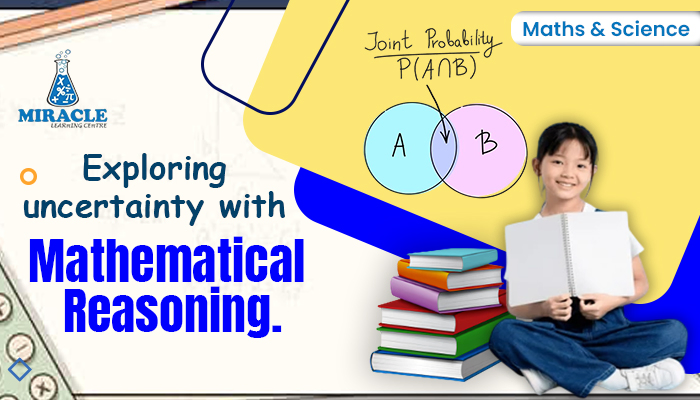
P(A|B)
This means the chance of event A happening after you already know that event B has happened. You have to adjust the total possible outcomes to reflect the new information.
Handling JC Level Probability Theory Problems
By the time you reach JC Level Maths, the questions become much more complicated and analytical. Now those start testing how well you can organise information and think through multiple steps calmly.
If you’re already feeling the jump, know that it’s normal. However, the good news is, you can manage it well once in our JC maths tuition classes you get an idea what examiners are actually looking for in your answers.
For example, in –
- Permutations and Combinations – You will face questions where counting becomes the main challenge. Sometimes order matters, like arranging people in seats. Sometimes it does not, like choosing a committee. If you mix these up, the entire answer goes wrong. You need to pause and ask, “Does arrangement matter here?”, before writing anything.
- Random Variables – Now you are not just finding a single chance. You are describing possible numerical outcomes. For example, how many successes might occur in repeated trials. You learn to build probability distributions and read them properly.
- Expectation and Variance – Expectation tells you the long term average result. Variance shows how spread out the outcomes are. These ideas may sound abstract at first, but once you connect them to clear examples, they become manageable.
- Normal Approximation – Some binomial questions become messy to calculate directly. Under certain conditions, you are allowed to use a normal distribution instead. The key is knowing when it is valid and remembering the continuity correction.
How we do it at our maths tuition classes:
For starters, we don’t rush through these topics just for the sake of completing the syllabus. At Miracle Learning Centre, we break concepts down in a way that makes sense to you at every step. We also make you practise common exam style problems as well as unfamiliar question types, so when you walk into your H2 paper, you don’t face ugly surprises.
The Stronger The Concepts, The Better The Results
Probability Theory is for understanding more and not merely calculating. If you know it inside out, are aware of all the laws and have built a solid foundation in tackling unfamiliar questions, you have no reason to panic.
Most of the students at our maths tuition classes know how to define outcomes, choose the correct rule to apply, interpret phrases and present solutions in a format that examiners love to read.
Parents often tell us they see a difference in confidence once their child truly understands the reasoning behind each step. And that confidence translates directly into better performance at the exams.
If your child finds Probability confusing or wants to strengthen their grasp of the theory, consider enrolling in our tuition programme. With the right guidance, this topic can shift from being a source of stress to one of the most reliable scoring areas in the syllabus.