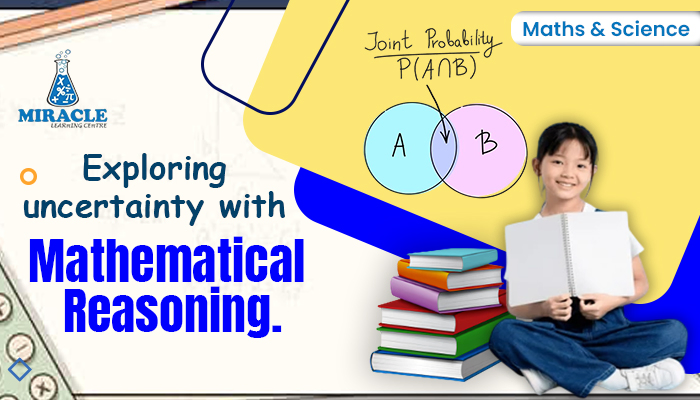
Mathematics becomes much easier when you understand the why behind concepts instead of just memorising formulas. Topics like Geometry & Probability are especially important because they combine visual thinking with logical reasoning—skills that are essential for exams and beyond.
At Miracle Learning Centre Singapore, our math tuition classes focus on helping students build this understanding step by step. In this guide, we’ll explore circle theorems, similarity of triangles, and probability in a clear and practical way.
What is Geometry and Probability?
Geometry is the study of shapes, sizes, and spatial relationships. It helps us understand how lines, angles, and figures behave and interact. Probability, on the other hand, measures uncertainty—it tells us how likely something is to happen.
When combined, Geometry & Probability allows students to solve problems that involve both visual interpretation and logical calculation. This is why these topics are heavily tested in school exams.
Circle Geometry Theorems (Building Strong Foundations)
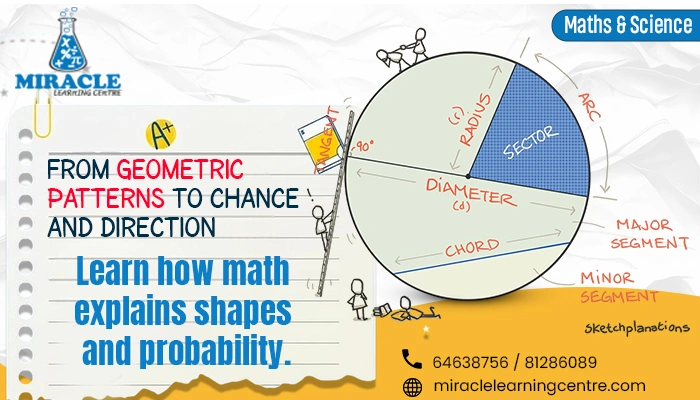
Circle geometry is based on one key idea: all points on a circle are equidistant from the centre. This simple concept leads to many powerful theorems that appear frequently in exam questions.
Understanding these theorems helps students recognise patterns instead of guessing answers.
Key Theorems to Remember
Here is a useful circle theorems list:
- Angle in a semicircle is always 90°
- A tangent is perpendicular to the radius
- Angles in the same segment are equal
- A perpendicular from the centre bisects a chord
- Tangents from the same external point are equal
How to Think About Circle Questions
Instead of memorising blindly, students should:
- Look for radii and tangents first
- Identify equal angles or symmetrical parts
- Combine multiple theorems in one question
In our math tuition classes, we train students to see patterns instantly, which saves time during exams.
Similarity of Triangles (Understanding Shape and Scale)
Similarity is an important concept in geometry that explains how shapes can be the same even if their sizes are different. When two triangles are similar, their angles remain equal, and their sides follow a consistent ratio.
This concept is widely used in geometry problems, especially those involving parallel lines, scaling, and proportions.
Main Similarity Tests
Students should remember these three conditions:
- AAA → Equal angles guarantee similarity
- SAS → Two sides in proportion with equal included angle
- SSS → All sides in the same ratio
Conceptual Understanding
Similarity is not limited to triangles:
- All circles are similar
- All squares are similar
- Shapes can be enlarged or reduced without changing their structure
Useful similarity of triangles tricks
- Parallel lines often create similar triangles
- Work with ratios instead of solving full lengths
- Always match corresponding sides carefully
With practice in math tuition, students learn to identify similarity quickly, making this a high-scoring topic.
Probability
Probability helps us measure how likely an event is to occur. It is widely used in real life—from predicting weather to analysing risks in finance.
The value of probability always lies between 0 and 1, where 0 means impossible and 1 means certain.
Basic Idea
Probability = favourable outcomes ÷ total outcomes
This simple formula is the foundation for solving all probability questions.
Why It Matters
Probability is not just theoretical—it develops logical thinking and decision-making skills. Students who understand probability well often perform better in data-related and analytical questions.
Combined Events
When more than one event is involved, probability becomes slightly more complex—but also more interesting.
The key is to understand how events are related to each other.
Types of Combined Events
- Independent Events (AND rule) – Multiply probabilities when events do not affect each other
- Mutually Exclusive Events (OR rule) – Add probabilities when events cannot happen together
- General Addition Rule – Subtract overlap when events can occur together
- “At Least One” Rule – Use complement: → 1 − probability of none
Practical Approach
Students should:
- Draw tree diagrams for step-by-step events
- Use tables to list all outcomes
- Avoid guessing—always organise information clearly
These structured methods are a key part of our math tuition teaching approach.
Geometric Probability
Geometric probability combines geometry with probability by using measurements like length and area instead of counting outcomes.
This is especially useful when dealing with continuous outcomes, where listing all possibilities is not practical.
Core Concept
Probability =
Favourable geometric measure ÷ Total measure
How to Understand It
Instead of counting outcomes:
- Measure lengths, areas, or regions
- Compare favourable parts to the whole figure
For example, if a point is randomly chosen in a square, the probability that it lies inside a circle depends on the area ratio.
Final Thoughts
Mastering Geometry & Probability is about understanding relationships, not memorising formulas.
To summarise:
- Use the circle theorems list to recognise patterns
- Apply similarity of triangles tricks to solve faster
- Understand probability rules instead of memorising them
- Visualise problems, especially in geometric probability
Improve Your Math with Miracle Learning Centre
If you want your child to gain confidence and excel in math:
Visit: miraclelearningcentre.com
Join our expert-led math tuition for Primary, Secondary & JC
At Miracle Learning Centre Singapore, we help students:
- Build strong concepts
- Apply exam strategies
- Achieve consistent improvement